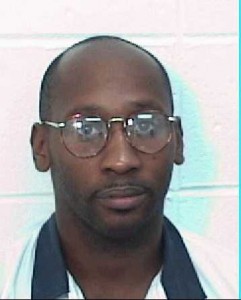
Georgia death row inmate Troy Davis is facing the possibility of his fourth execution date in four years after the US Supreme Court dismissed his appeal on 28 March. Doubts persist about his guilt in the crime for which he was sentenced to death two decades ago.
Troy Davis was sentenced to death in 1991 for the murder of police officer Mark Allen MacPhail in Savannah, Georgia in 1989. No physical evidence directly links Davis to the murder – no murder weapon was ever found. The case against Davis primarily rested on witness testimony. Since his trial, seven of nine key witnesses have recanted or changed their testimony, some alleging police coercion.
In 2009, the US Supreme Court ordered a federal evidentiary hearing to review Troy Davis’ innocence claim.
At the hearing in June 2010, US District Court Judge William Moore addressed not whether the state could demonstrate a watertight case against Troy Davis, but whether Davis could show “by clear and convincing evidence that no reasonable juror would have convicted him in the light of the new evidence” that had emerged since his 1991 murder trial. Under this “extraordinarily high” standard, Judge Moore wrote, “Mr Davis is not innocent”. Elsewhere in his ruling, however, he acknowledged that the new evidence presented by Troy Davis cast “some additional, minimal” doubt on his conviction, and that the state’s case was not “ironclad”. In 1991, the jury had found Troy Davis guilty “beyond a reasonable doubt,” Judge Moore noted, “but not to a mathematical certainty”.
On 28 March, the US Supreme Court refused to take the Davis case, clearing the way for Georgia to set an execution date. Troy Davis was less than 24 hours from execution in 2007 when the Georgia Board of Pardons and Paroles issued a stay. The Board said in 2007 that it would not allow an execution to go ahead “unless and until its members are convinced that there is no doubt as to the guilt of the accused”. Since then Troy Davis has faced two more execution dates, both in 2008, which were stayed by the courts.
Since 2007, three states in the USA have legislated to abolish the death penalty. When signing the abolitionist bills into law the three state governors all pointed to the risk of irrevocable error as a reason to support abolition. Since Troy Davis has been on death row, more than 90 prisoners have been released from death rows around the country on grounds of innocence. In each case, at trial the defendant had been found guilty beyond a reasonable doubt.
For more information about Troy Davis case, see
here and
here from Amnesty International.
RECOMMENDED ACTION: Please send appeals to arrive as quickly as possible:
-Acknowledging the seriousness of the crime for which Troy Davis was sentenced to death;
-Noting that doubts persist in the case even after the federal evidentiary hearing in 2010;
-Pointing out that the Board acts as a failsafe against irreversible error, and recalling its statement in 2007 that it would not allow any execution to proceed where there was any doubt about the guilt of the prisoner;
-Pointing to the substantial evidence of the fallibility of the capital justice system;
-Calling on the Board to grant clemency and to commute the death sentence of Troy Davis.
APPEALS TO:
State Board of Pardons and Paroles
2 Martin Luther King, Jr. Drive, SE
Suite 458, Balcony Level, East Tower
Atlanta, Georgia 30334-4909, USA
Salutation: Dear Board members
You can
email us for more information about Troy Davis or advice on what you can do to help.
I also have some statistics about the reliability of witness testimony from studying psychology this year, which we might be able to quote to back up our arguments.
 Hello friends. I apologise again for my recent lack of activity. Bear with me. I recently started university and, as you can imagine, it's made a significant impact on my life.